Manufacturers are always looking for ways to improve product quality, reduce waste, and keep production moving efficiently. While traditional welding remains a common joining method, many manufacturers are turning to inertia friction welding because it creates strong, reliable welds without melting the materials being joined.
But what exactly is inertia friction welding, and why is it used in so many demanding applications?
In this guide, we’ll explain how inertia friction welding works, what makes it different from traditional welding methods, and why manufacturers across a range of industries rely on it every day.
Table of Contents
What Is Inertia Friction Welding?
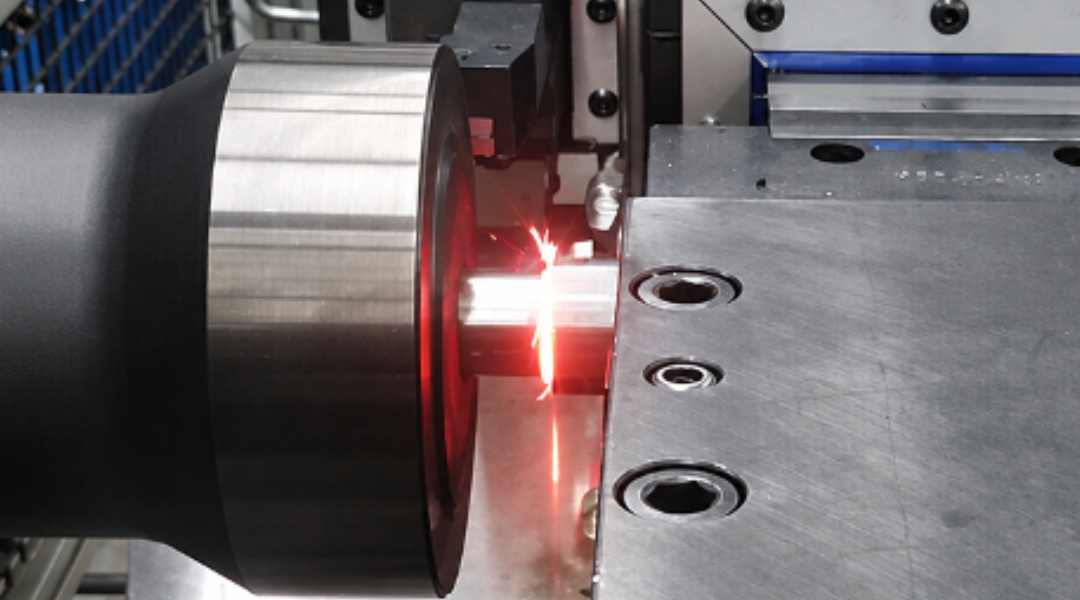
Inertia friction welding is a solid-state welding process that joins two materials using friction-generated heat and pressure rather than melting them together.
During the process, one component rotates while the other remains stationary. As the two parts are pressed together, friction creates heat at the joint. This heat softens the material enough for a strong bond to form when force is applied. Because the materials are not melted, the process can produce highly consistent and reliable welds.
How Does the Inertia Friction Welding Process Work?
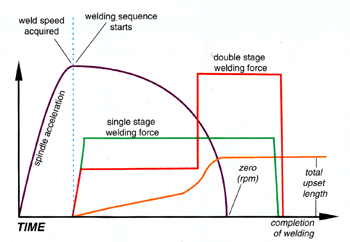
The inertia friction welding process follows a consistent sequence of steps. Each stage plays an important role in creating a durable welded joint.
Step 1: Energy Is Stored – The process begins with a flywheel spinning at a predetermined speed that is based on the component size. These speeds typically range from several hundred to over a thousand RPM for small parts, and even more for large components. As it rotates, it stores kinetic energy that will later be used to generate heat.
Step 2: Components Are Brought Together – Once the desired speed is reached, the rotating component is pressed against a stationary component under controlled pressure.
Step 3: Friction Generates Heat – As the surfaces make contact, friction creates heat at the meeting point between the two parts. This heat softens the material without melting it.
Step 4: Rotation Stops – As the stored energy is used, the flywheel slows to a stop.
Step 5: Forge Pressure Creates the Weld – Once rotation stops, additional force is applied. This pressure forges the softened materials together, creating a solid bond.
Why Is Inertia Friction Welding Different from Traditional Welding?
The biggest difference between inertia friction welding and many traditional welding methods is that the base materials are not melted during the joining process.
This difference can provide several advantages:
Because the process avoids melting the materials, manufacturers can often achieve more consistent results while reducing some of the challenges associated with traditional fusion welding.
Key Benefits of Inertia Friction Welding
Manufacturers choose inertia friction welding for several reasons, especially when quality and production efficiency are top priorities.
Superior Weld Strength
A weld is only as valuable as its ability to perform under real-world conditions. That’s why manufacturers evaluate weld quality using tests such as tensile strength, fatigue resistance, impact testing, and bend testing.
One of the biggest advantages of inertia friction welding is that it creates a solid-state bond rather than melting and re-solidifying the material. Because the process produces a smaller heat-affected zone and avoids many of the defects associated with fusion welding, manufacturers can often achieve highly consistent mechanical properties across the joint.
In many applications, inertia friction welds can achieve strength comparable to, or even greater than, the base material itself.
Benefits include:
- High tensile strength
- Excellent fatigue performance in demanding applications
- Reduced risk of porosity and weld defects
- Consistent performance from part to part
Excellent Repeatability
Making one good weld is important. Making the same good weld over and over again is what really matters.
That’s where inertia friction welding shines. The process uses controlled speed, pressure, and energy to help produce consistent results from part to part. IFW’s equipment is designed to give manufacturers reliable weld quality throughout production, whether they’re making a few parts or running high-volume jobs.
Benefits include:
- Consistent weld quality
- Less scrap and rework
- Better production efficiency
- Reliable results at higher volumes
Faster Production Cycles
The process is well suited for production environments because weld times are often short.
Advantages may include:
- Higher throughput
- Increased productivity
- Better support for high-volume manufacturing
Material Savings
Material waste can add significant cost to a manufacturing operation. In many applications, inertia friction welding allows manufacturers to join near-net-shape components rather than machine parts from larger pieces of material. This can help reduce the amount of raw material removed during production.
The impact can be substantial. In one documented manufacturing case study, an OEM reported reducing material waste by up to 70% after adopting an inertia friction welding process. The company had previously lost 40% to 70% of its raw material through machining operations, with some parts losing more than half of the original billet.
Additional benefits may include:
- No filler material required
- Less material removed through machining
- Reduced scrap and rework
- More efficient use of raw materials
- Lower overall production costs
Ability to Join Challenging Materials
Some materials can be difficult to join using conventional welding techniques. Inertia friction welding can provide an effective solution for certain specialized applications.
Common Applications for Inertia Friction Welding
The reliability and repeatability of inertia friction welding make it valuable across many industries.
Automotive Industry
Aerospace Industry
Oil and Gas Industry
Industrial Manufacturing
Defense Applications
When Should Manufacturers Consider Inertia Friction Welding?
Manufacturers often explore inertia friction welding when looking for ways to improve performance, consistency, or production efficiency.
The process may be a good fit when the goal is to achieve:
- Consistent weld quality
- Greater production efficiency
- Lower manufacturing costs
- Stronger component performance
- High-volume production capabilities
- Reliable joining of challenging materials
If weld quality, throughput, or product reliability have become ongoing concerns, inertia friction welding may be worth evaluating as part of your manufacturing strategy.
The Role of Modern Friction Welding Equipment
Today’s friction welding systems offer greater precision, process control, and repeatability than ever before. Modern equipment can include advanced controls, process monitoring capabilities, automation features, and specialized technologies such as direct drive and hybrid welding systems.
These advancements help manufacturers improve consistency, reduce variability, and better integrate welding operations into modern production environments.
Why Manufacturers Choose IFW
Manufacturers often look for a partner that understands both the welding process and the equipment required to support it.
IFW provides expertise in inertia friction welding technology through:
- New welding systems
- Reconditioning services
- Prototype welding capabilities
- Software solutions
- Automation support
By supporting manufacturers across multiple stages of the welding process, IFW helps companies evaluate and implement solutions that fit their production needs.
Why More Manufacturers Are Choosing Inertia Friction Welding
Strong welds. Consistent results. Efficient production.
That’s why manufacturers across a wide range of industries continue to invest in inertia friction welding. Understanding the process is the first step in deciding whether it’s the right solution for your operation.
Ready to Learn More?
Interested in exploring how inertia friction welding can support your production goals? Contact IFW to discuss your application and find the right welding solution for your operation.