
Processes
Direct Drive
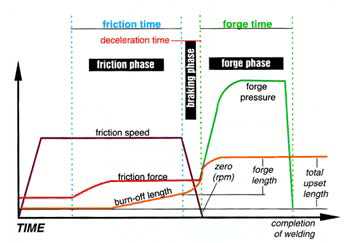
Direct Drive Friction Welding utilizes a powered spindle that continuously rotates one workpiece while controlled pressure is applied to the mating component. Heat is generated through friction until the ideal welding condition is achieved, after which rotation stops and forge pressure completes the bond.
Benefits
- Precise control over speed, pressure, and weld parameters
- Short cycle times for high-volume production
- Excellent repeatability
- Reduced secondary machining requirements
- Suitable for a broad range of material combinations
Why Choose Direct Drive Welding?
Direct Drive welding provides manufacturers with maximum control over the welding cycle, making it an ideal solution for applications requiring consistent production throughput and tight process tolerances.
Inertia
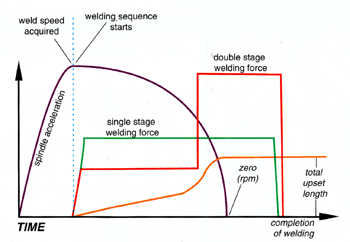
Inertia Friction Welding uses stored rotational energy to generate heat at the weld interface. During the process, one component is accelerated to a predetermined speed and stores energy in a rotating flywheel system. Once the desired energy level is reached, the rotating component is forced against a stationary workpiece under controlled pressure, creating a solid-state weld.
Benefits
- Exceptional weld strength and repeatability
- Ideal for joining high-performance alloys and dissimilar metals
- Minimal heat-affected zone
- Reduced material waste compared to traditional fusion welding
- Excellent process consistency for production environments
Why Choose Inertia Welding?
Inertia welding excels when precision, repeatability, and metallurgical integrity are critical. The process delivers highly consistent welds while minimizing distortion and preserving the properties of the parent materials.
Hybrid
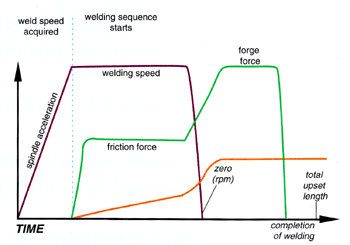
Hybrid Friction Welding combines the advantages of inertia and direct drive technologies to provide greater flexibility and process optimization. By leveraging the strengths of both methods, manufacturers can achieve exceptional control over heat input, upset, and weld quality while accommodating a wider variety of component geometries and materials.
Benefits
-
Expanded process capabilities
-
Greater application flexibility
-
Enhanced control of weld parameters
-
Improved productivity and efficiency
-
Adaptable to complex or specialized components
Why Choose Hybrid Welding?
For challenging applications where traditional welding methods may be limited, Hybrid Friction Welding offers an ideal balance of performance, precision, and production efficiency.
Contact Us
Have questions? Or do you want to discuss your welding needs? Our team is here to help! Contact IFW today to learn more about our services and how we can support your next project.